Chapter 9
Enterprise edition only
Erasure Coding Backend
EC Model
- EC profile
- Stripe
- Shard
- Topology safety
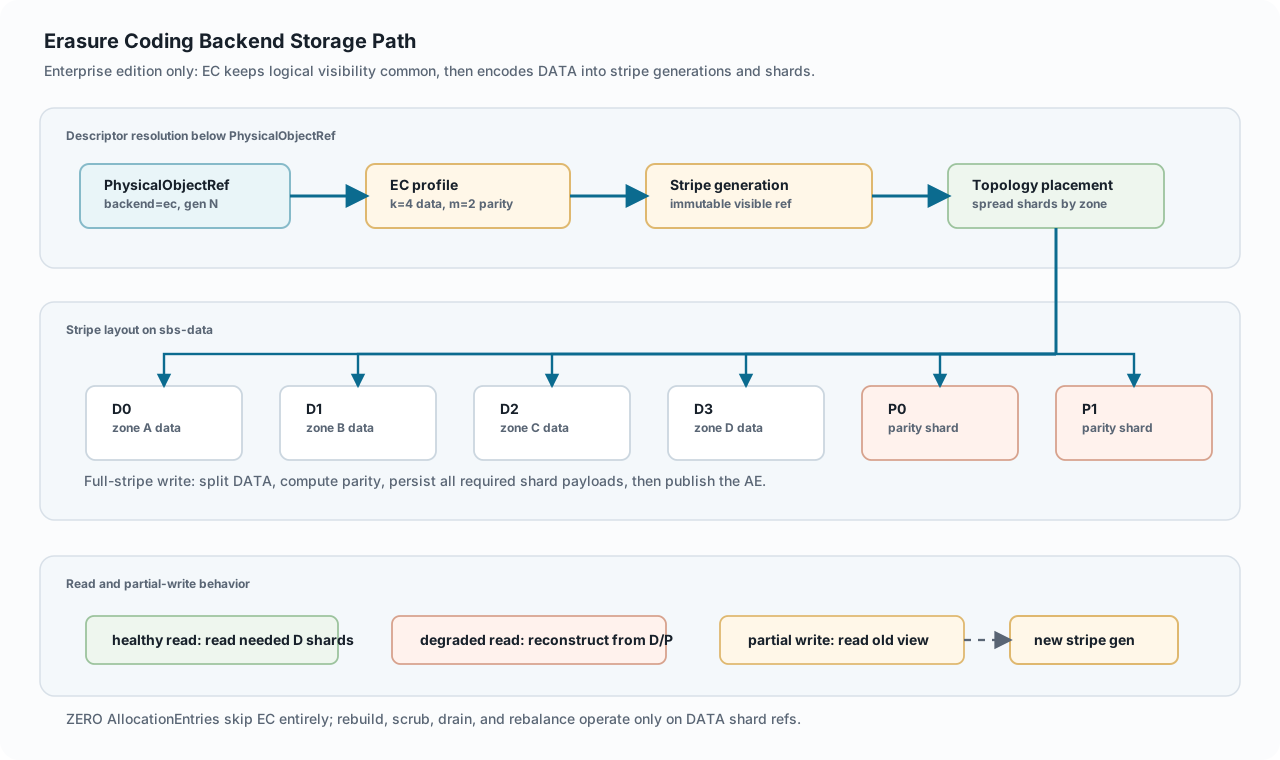
Erasure Coding is a backend descriptor under the same AllocationEntry and PhysicalObjectRef model. EC changes how payload is encoded, placed, reconstructed, and maintained. It does not create a new metadata authority or bypass read-view and reachability rules.
An EC-backed write becomes visible only when SBS metadata commits an AllocationEntry that points at a stable EC PhysicalObjectRef. EC placement, repair, rebuild, scrub, drain, and expansion remain sbs-service authority.
What Is Different In EC Mode
EC mode keeps the same logical resolver but changes the payload unit below PhysicalObjectRef. A data-bearing entry resolves to an EC descriptor that names a profile, stripe generation, shard refs, checksums, and topology evidence. Reads may use data shards directly or reconstruct from data/parity shards; writes publish a new stripe generation or replacement PhysicalObjectRef rather than overwriting a reachable stripe in place.
| Concern | Common Logical Rule | EC Backend Rule |
|---|---|---|
| Zero read | AllocationEntry kind=zero returns zeroes without payload access. |
No shard is contacted because no EC PhysicalObjectRef is produced. |
| Healthy read | The read view resolves a data/shared entry to an EC PhysicalObjectRef. | The backend reads the needed data shards when enough are available. |
| Degraded read | The visible object identity still comes from committed metadata. | The backend reads a sufficient set of data/parity shards and reconstructs missing data within the profile tolerance. |
| Write | New data becomes visible only after AllocationEntry metadata commit. | Full-stripe writes encode k data plus m parity shards; partial writes read the old view as needed and publish a new stripe generation or replacement ref. |
| Maintenance | Reachability and read-view roots decide which objects must stay protected. | Rebuild/scrub/rebalance/drain operate on shard refs and must preserve topology safety before publishing replacement shard metadata. |
EC Records And Shard Layout
EC is written as the enterprise backend in this edition, not as a separate future model. The common logical mapping still points at a PhysicalObjectRef. The backend descriptor below that reference names the EC profile, stripe generation, shard refs, checksums, and topology evidence needed to read or rebuild the object.
| Layer | Representative Record / Key | Purpose |
|---|---|---|
| Volume policy | VolumeSpecRecord, admin/volumes/<id>/spec |
Stores backend=ec, EC profile id, failure domain, topology mode, and expansion policy. |
| Logical mapping | AllocationPageRecord, volumes/<id>/allocation/pages/<page> |
Publishes AllocationEntries that point at EC PhysicalObjectRefs or zero state. |
| EC object descriptor | PhysicalObjectRecord with EC descriptor fields |
Names stripe id, stripe generation, profile, shard refs, checksums, and zone shard counts. |
| Shard payload | Node-local sbs-data Pebble shard keys |
Holds encoded data or parity shard bytes. Local inventory is not global reachability truth. |
| Maintenance operation | ECMaintenanceOperationRecord or volume operation record |
Persists rebuild, scrub, rebalance, or drain progress, idempotency, blocked reason, and resume point. |
EC Profile
| Profile Field | Meaning |
|---|---|
codec_id |
Systematic Reed-Solomon profile identifier for the current baseline. |
k data shards |
Number of data shards needed for normal data layout. |
m parity shards |
Number of parity shards; also the default one-zone shard cap. |
stripe_unit_bytes |
Payload unit size for each shard in a stripe. |
failure_domain |
Current managed domain is zone. |
Topology-Safe Placement
Strict one-zone-tolerant EC placement requires that a single zone loss cannot remove more shards than parity can reconstruct. The simple review rule is:
max_shards_in_any_single_zone <= m
If the selected failure-domain policy cannot satisfy this bound, strict placement should fail or report weak placement rather than silently publishing a weaker stripe.
Read And Maintenance
| Operation | Architecture Meaning |
|---|---|
| Healthy read | Read data shards directly when enough data shards are available. |
| Degraded read | Reconstruct missing data from available data/parity shards. |
| Partial write | Publish a new stripe generation or PhysicalObjectRef rather than overwriting a reachable object in place. |
| Rebuild/scrub/drain | Run under SBS maintenance authority while preserving read-view and reachability roots. |
How EC Writes And Reads Work
| Path | Flow | Visibility Boundary |
|---|---|---|
| Full-stripe write | Split payload into k data shards, compute m parity shards, place shards by topology policy, persist shard payloads, then publish the EC PhysicalObjectRef. |
The AllocationEntry commit makes the stripe visible. |
| Partial write | Read the old view as needed, produce a new stripe generation or replacement PhysicalObjectRef, and commit metadata by swap. | Readers never depend on in-place overwrite of a reachable EC stripe. |
| Healthy read | Resolve logical mapping, choose the needed data shards, read shard payloads, and return the requested bytes. | Read identity comes from the read view and committed AllocationEntry. |
| Degraded read | Read any sufficient set of data/parity shards and reconstruct missing data within profile tolerance. | Degraded reconstruction does not publish new placement by itself. |
Maintenance State Machines
| Operation | States | Architecture Rule |
|---|---|---|
| Rebuild | queued -> planning -> copying -> verifying -> committing -> complete, with blocked and failed exits. |
Choose topology-safe targets, reconstruct missing shards, verify payload, then publish replacement shard refs. |
| Scrub | queued -> scanning -> verifying -> repairing_optional -> complete. |
Detect checksum or shard drift without changing logical read-view identity. Repair uses the rebuild authority path. |
| Rebalance | queued -> planning -> moving -> verifying -> committing -> complete. |
Improve balance only when topology safety is preserved. Byte balance is lower priority than failure-domain safety. |
| Drain | preflight -> planning -> moving -> verifying -> committing -> drained, or blocked. |
Do not move shards away from a node or zone if the post-drain topology would be unsafe unless an explicit weak mode is admitted and reported. |